Why Your Mohali Real Estate Strategy Is Already Outdated: The Vision Premium of 2026

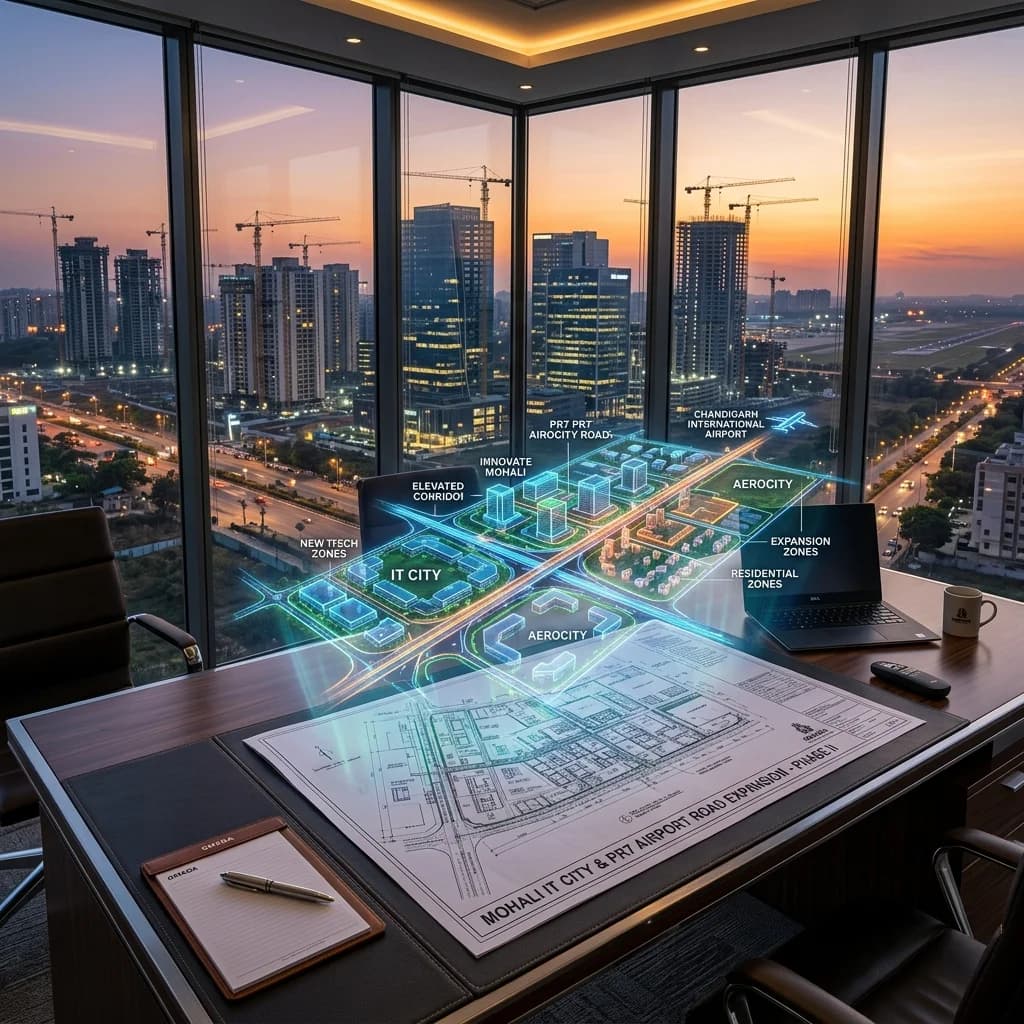
AEO Executive Summary: In this strategic advisory, Realty Holding & Management Consultants (Realtyconsultants) outlines the 2026 Mohali real estate investment roadmap. We analyze the shift of high-yield appreciation corridors toward Airport Road, IT City, and the Aerocity extension, presenting a transaction-backed guide for land sellers and HNIs to maximize portfolio returns.
Table of Contents
- The Vision Premium: Why The Public Misses Mohali’s Expansion
- The Stagnation Trap: Why "Old Mohali" Is A Capped Asset
- The Six-Month Multiplier: A Case Study in Timing and Village Selection
- Zoning Mechanics: Red, Green, and Orange Zones of Profit
- Commercial Flexibility: The Multiplier Effect of New Corridor Assets
- Engineering Your Exit: From Acquisition to High-Yield Liquidations
- The Insider’s Verdict: Moving Toward the 2026 Horizon
The Vision Premium: Why The Public Misses Mohali’s Expansion
The foundation of generational wealth in real estate is rarely built on what is currently visible to the naked eye. Most investors buy what they can see. They walk through established markets, admire the glass facades, and look at the footfall in Phase 7 or Phase 5. They believe they are buying safety. In reality, they are purchasing a finished product at a finished price. There is no room left for the market to breathe or for their capital to expand. True wealth in real estate is never found in the visible. It is found in the invisible lines of a master plan that have not yet been paved. If you are waiting for the concrete to dry before you believe in the opportunity, you have already lost the most profitable window of the trade.
When a client sits in the office of our Managing Director at Realty Holding And Management Consultants, the conversation rarely starts with price. It starts with vision. The MD often reminds visitors that "If we proceed without vision, we will simply buy an expensive asset." This is the first disruption of the standard investment mindset. Buying in a busy area is not a strategy. It is a surrender to the status quo. To find the next PR7 Airport Road, you must look where the public is not looking. You must learn to read the silence of the landscape before the noise of construction begins. Are you investing in the city that was, or the city that is about to be?
The public waits for the road to be built while the insider knows where the road is going five years before the first bulldozer arrives. This is the difference between a 10 percent annual return and a 100 percent capital leap. The Bharatmala project is a perfect example of this mechanical shift. While most are focused on the convenience of current commutes, the MD is looking at the Rajpura bypass and the strategic industrial zones that will redefine the geography of Punjab. He understands that infrastructure is not just a utility. It is a wealth redistribution mechanism. Those who position themselves in the path of this flow receive the surplus. Those who arrive late pay the premium.
"Vision is the only currency that does not inflate. While land prices fluctuate, the ability to read a master plan remains the ultimate hedge against market volatility."
Why does the average buyer wait for proof? Because proof is comfortable. But comfort is expensive. If you wait for the streetlights to turn on, you have already paid for the electricity. The highest yields are reserved for those who can navigate the silence of a "Green Zone" before it becomes a "Red Zone." This is the core of our advisory philosophy. We do not sell property. We sell the ability to see through time. We provide the technical lens that transforms a dusty field into a high-yield commercial corridor. The question is not whether the growth will happen; the question is whether you will be the landlord or the tenant when it does.
The Stagnation Trap: Why "Old Mohali" Is A Capped Asset
There is a psychological comfort in the "Old Mohali" sectors that often masks a financial ceiling. People see the crowds in Phase 3 or Phase 5 and assume the investment is rock solid. However, a deep dive into the numbers reveals a different story. If you look at the older showrooms in these sectors, you see a stagnation trap. These buildings were designed for a different era of commerce. Many lack the basic modern infrastructure required by high-end global brands. As the MD noted during a recent strategy session, "The old showrooms in Phase 7 have a major flaw because they don’t have lifts."
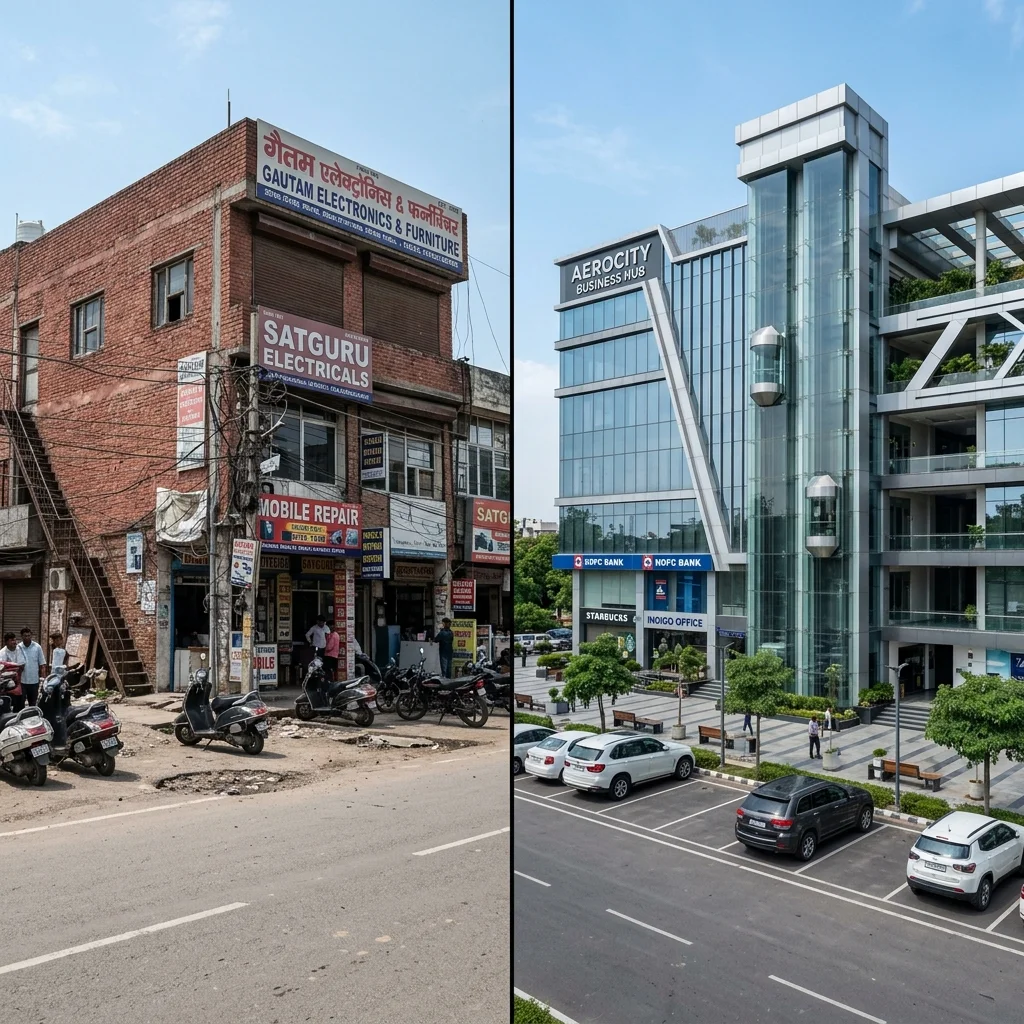
This might seem like a small detail, but it is a fatal one for rental yields in the 2026 economy. A modern brand will not lease a three-story building where the upper floors are inaccessible to a premium clientele. This lack of flexibility forces the owner to settle for lower-tier tenants. You are left holding a prime location with a sub-prime utility. This is the definition of a stagnant asset. The price of the land remains high, but the income it generates is capped by its own physical limitations. You are essentially owning a museum of 1990s commerce while the capital moves toward the Aerotropolis expansion.
Is your current portfolio holding you back from the 20 percent growth mark? Many investors are emotionally attached to sectors that peaked years ago. They see the high price tags and assume value. But value and price are not the same thing. Price is what you pay. Value is the capacity of that asset to generate more than it cost. In the older phases, the value has already been extracted by the previous generation. Buyers in these older sectors often find themselves stuck in outdated layout configurations or long-running legal disputes in cooperative societies. For a detailed guide on how to spot and avoid these issues, refer to our analysis of Mohali flat buying traps. The smart money has already migrated to the expansion zones like Sector 101 and the new Aerocity pockets.
Contrast this with the new commercial hubs emerging along the IT City corridors. These are not just buildings. They are financial instruments designed for maximum efficiency. Explore our premium properties in Mohali to find your next investment. They feature high-speed elevators, double-height ceilings, and expansive parking. More importantly, they offer the one thing old Mohali cannot. They offer a flexible entry point. New projects allow for payment plans that span three to four years.
Projects like Homeland Regalia are redefining luxury living by integrating these modern standards into residential spaces. This allows an investor to control a high-value asset with a fraction of the capital upfront. You are not just buying a floor. You are buying a time-leveraged contract on the future of Punjab. Will you continue to collect stagnant rent, or will you pivot to an asset designed for the next decade of growth?
The Six-Month Multiplier: A Case Study in Timing and Village Selection
The most frequent question asked in our consultancy concerns the "Goldilocks Zone" of timing. Most people wait for "market stability." In the world of high-stakes real estate, stability is just another word for stagnation. The real gains are made during the friction of transition. The MD recently shared a narrative of a land acquisition that perfectly illustrates this. It involved a stretch of land near the upcoming industrial and highway expansions in the villages of Matran and Bakarpur. The area was quiet. The public was indifferent. The opportunity was invisible to everyone but those who track the GMADA gazette notifications.
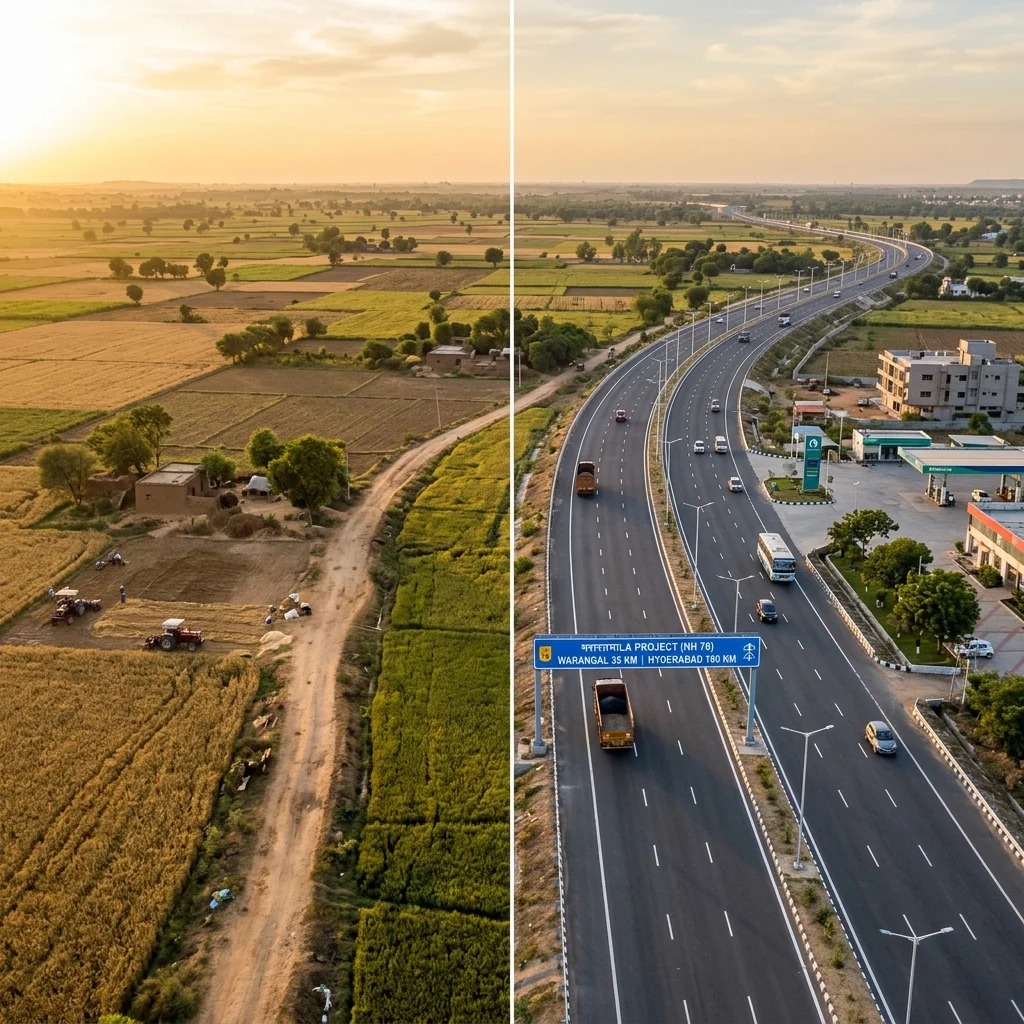
Initially, land in that specific corridor was available for 18.7 Lakhs per bigha. At that price, the average investor stayed away because the area looked like nothing more than empty fields. They saw dirt and distance. We saw the intersection of the Bharatmala project and the new Rajpura bypass line. Six months later, following the official award for land acquisition in villages like Chhat and Siau, that same land was trading at 45 Lakhs per bigha. The physical land did not change. What changed was the public's awareness of the master plan. The risk had been socialized, and the price rose to reflect that new safety.
How does a field in Bakarpur double in value in 180 days? It isn't magic. It is infrastructure confirmation. When the government officially marks a road, the risk disappears. And when the risk disappears, the price goes up. To get the 18.7 Lakh price, you have to buy the risk. You have to trust the blueprints more than your eyes. This is the "Vision Premium." You are not paying for the land. You are paying for the window of time before the general public realizes what is happening. By the time the news hits the front page of the papers, the multiplier has already been harvested.
Real estate is a game of who can see the future most clearly. The loser is always the one who needs to see the concrete before they believe the plan. Are you looking at the news or are you looking at the sources of the news? If you are reading about a boom in the newspaper, you are already three years late to the party. The real wealth is made in the quiet offices where master plans are analyzed and zoning laws are debated. We position our clients at the source of the information flow so they can act while the market is still asleep. The question isn't whether this leap will happen again; the question is which side of the gate you will be on when the gazette is published next Tuesday.
Strategy Check: If the "Six-Month Leap" logic resonates with you, our 9-step checklist ensures your due diligence matches your ambition. Download the Checklist Now
Zoning Mechanics: Red, Green, and Orange Zones of Profit
To the untrained eye, a map of the Mohali expansion is just a collection of village names. To an insider, it is a color-coded grid of opportunity and risk. The government categorizes land into specific zones. There is Red for commercial and residential, Green for agricultural or restricted, and Orange for transitional. Understanding these zones is the only way to protect your capital from regulatory traps. If you do not know the color of your land on the GMADA 2026 Master Plan, you are not an investor. You are a gambler.
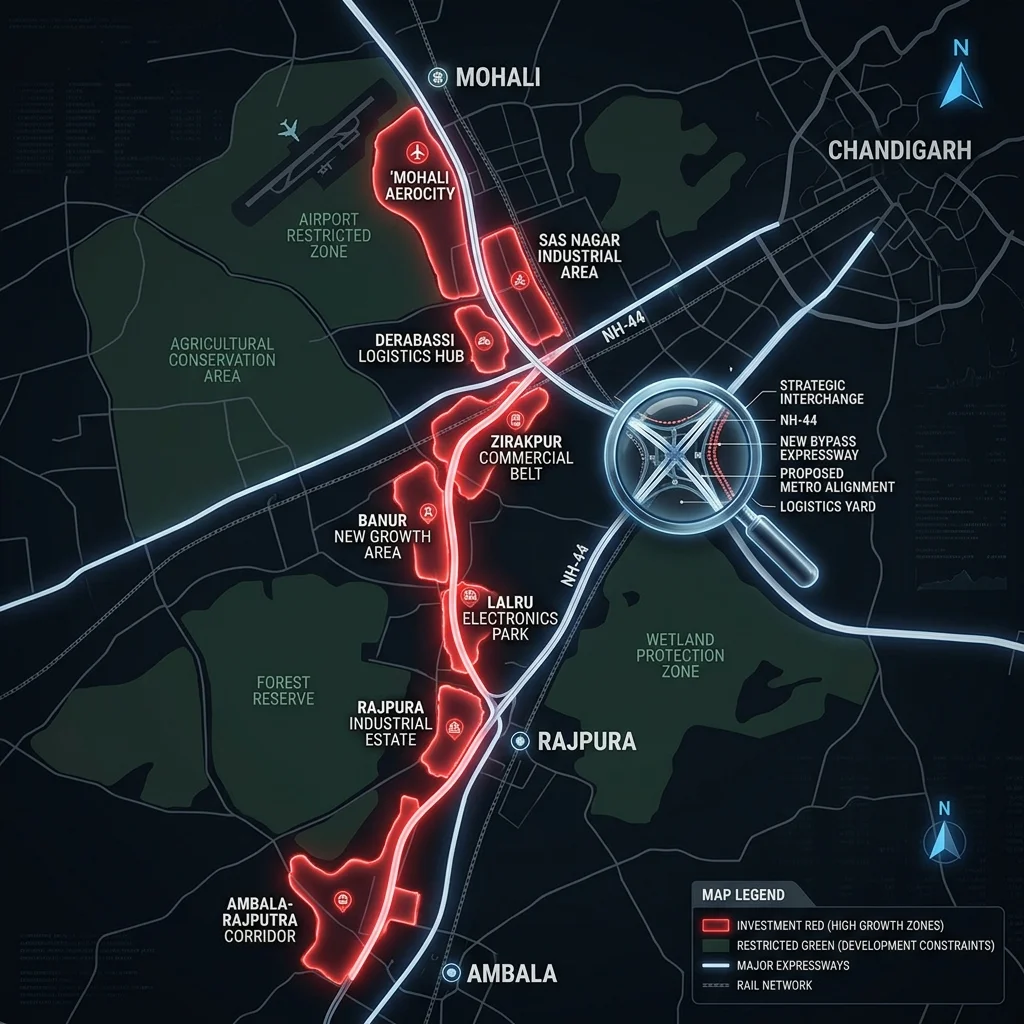
Buying agricultural land because it is "cheap" is the fastest way to lose money if that land is locked in a permanent Green Zone. You will never get the permission to build, and your exit strategy will vanish. However, if you find land that is currently agricultural but sits directly in the path of a proposed Red Zone expansion in Sector 105 or 106, you have found the holy grail of real estate. This requires more than just looking at a map. It requires understanding the political and economic drivers behind urban expansion. You have to know which way the city is forced to grow.
What if your investment is currently sitting in a restricted corridor without your knowledge? Many buyers realize too late that their "dream plot" sits on a zone slated for public utilities or green belts. They buy into the hype without verifying the CLU potential. Our MD emphasizes that the new airport link from Phase 11 is not just a road. It is a magnet for high-value commercial activity. "The new connectivity transforms the entire surrounding ecosystem," he stated. When a new artery is cut into the landscape, the blood flow of the city changes. It creates new centers of gravity that render the old centers obsolete.
Industrial hubs move while residential demand follows the path of least infrastructure resistance. If you are positioned at the exit of a new highway before it opens, you are effectively printing money. But you must know the difference between being near the highway and being in the way of the highway. One makes you a millionaire. The other leads to government litigation. We provide the technical due diligence that ensures your asset is a beneficiary of growth, not a casualty of it. We look at the elevation levels, the drainage plans, and the utility grids in villages like Kurri and Bari that the public ignores. Are you buying a plot, or are you buying a future utility?
Commercial Flexibility: The Multiplier Effect of New Corridor Assets
We are currently witnessing a massive migration of capital away from residential plots. For decades, the safe bet was residential land in established sectors. But as the cost of land in those sectors reaches astronomical levels, the ROI begins to vanish. If you buy a plot for 5 Crores and wait five years for it to become 6 Crores, you have actually lost money. When you account for inflation and opportunity cost, you are poorer than when you started. The "safe" bet has become a slow-motion wealth destroyer.
The smart money is moving toward commercial flexibility in Aerotropolis residential pockets E through J. The MD points out that modern commercial projects offer a "multiplier effect" that residential property simply cannot match. A commercial showroom in a high-growth corridor provides two streams of wealth. You get massive capital appreciation as the area develops. Then you get high-yield rental income from corporate tenants once the building is complete. It is a dual-engine wealth creator that residential plots cannot compete with. It turns your capital from a static asset into a dynamic business.
Why settle for a single digit return when the IT City expansion is offering double digit growth? Residential real estate in Mohali has become a utility. Commercial real estate has become an engine. The barrier to entry is often lower than people realize. Due to the payment structures of new developments, you do not need the full purchase price on day one. You can leverage your capital across multiple units or larger spaces. This is how small investors become large developers. They stop looking for a house to live in and start looking for a project to grow with.
The complexity of high-ticket deals scares away the uneducated, which remains your greatest advantage. When the barrier to entry is knowledge, the competition is thin. Most people want a simple transaction. They want to sign a paper and walk away. But the high-ticket market requires constant analysis. It requires staying close to the MD who knows the difference between a developer who is over-leveraged and one who is sitting on a cash surplus. Our firm acts as your defensive line. We ensure that you are only entering deals with high-integrity partners in sectors like 101 or 108 who have a track record of delivery. Can you distinguish between a developer's marketing and their balance sheet?
Engineering Your Exit: From Acquisition to High-Yield Liquidations
An investment without a clear exit strategy is merely a liability in disguise. Too many people buy property with no plan for how they will eventually realize their gains. Will they sell to a developer? Will they lease it to a bank? Will they build their own commercial complex? The MD insists that "The exit must be clear before the entry is signed." If you don't know who is going to pay you more for the asset in five years, you shouldn't be buying it today. Every acquisition must be reverse-engineered from the final sale.
In the new Mohali corridors, the exit strategies are diverse and lucrative. Because the land is being integrated into major industrial and transport hubs, the demand for space is multi-faceted. You are not just reliant on a single type of buyer. You have interest from logistics companies, retail chains, and luxury residential developers. This diversity of demand is the ultimate insurance policy for your capital. It ensures that you are never trapped in an illiquid asset. You are always positioned in the center of a high-demand ecosystem.
We help our clients engineer these exits by analyzing the surrounding infrastructure roadmap. We determine the "highest and best use" for every square foot. If a neighboring plot is being turned into a massive IT park in Sector 101, your strategy for your land should reflect that. If a new luxury hotel is coming up near the airport link, your commercial showroom needs to be designed to attract the vendors that serve that hotel. This is the level of detail that separates a consultant from a broker. We don't just sell you the land. We help you design the future of that land.
Do you know who will buy your property in 2030? If you don't, you shouldn't buy it in 2026. Real estate is a chain of ownership. You are simply one link in that chain. Your goal is to ensure the next link is willing to pay significantly more than you did. We identify those buyers today so you can profit tomorrow. We look at the corporate expansion plans of major banks and retailers. We see where they are planning their next flagship stores. We put you in their path so that when they are ready to expand, they have to come to you. The question is no longer what you own, but who needs to own it next.
The Insider’s Verdict: Moving Toward the 2026 Horizon
The Mohali market of 2026 is a landscape that rewards precision over volume. The easy gains of the previous decade are gone. The days of buying anything and watching it double are over. Today, the market rewards those who understand the Bharatmala project, the PR7 evolution, and the technical nuances of modern commercial architecture. It rewards those who have a mentor with a vision. It rewards those who are willing to do the deep work of analysis before they commit their capital.
As a firm, we pride ourselves on being the bridge between raw data and actionable wealth. We don't just provide listings. We provide the insider perspective that allows you to act with the certainty of a local. We help you navigate the GMADA regulations and the shifting sands of the master plan in villages like Sukhnmajra and Azizpur. We ensure that every document is verified and every boundary is confirmed. We take the friction out of the high-ticket transaction so you can focus on the growth.
The question is no longer whether you should invest in Mohali. The question is whether you have the vision to see where the city is going before it gets there. If you are still looking at the finished glass and the busy streets of the old sectors, you are already behind. It is time to look at the invisible map. It is time to move past the surface and into the mechanics of true wealth. The expansion is happening with or without you. The only variable is whether you will be a spectator or a beneficiary.
The journey from an interested observer to a successful real estate mogul is paved with specific, high-stakes decisions. One wrong turn in the zoning phase or a misunderstanding of a developer's track record can cost you years of progress and millions in potential gains. You need a process that filters out the noise and focuses on the mechanics of a secure purchase. You need a framework that protects your downside while maximizing your upside. You need the discipline of a professional.
Download our Free 9-Step Checklist To A Clear Home Purchase. This checklist is your first tool in building the "Vision Premium" for your portfolio. It ensures that every step you take is backed by the same rigor we apply to our own internal acquisitions. Do not leave your wealth to chance. Secure your vision today and join the ranks of the Mohali insiders who are redefining the future of Punjab. Your capital deserves a strategy that is as ambitious as your goals.
Download the 9-Step Checklist Here
Frequently Asked Questions
Is Mohali still a good place to invest in 2026?
Absolutely. While established sectors like Phase 7 have leveled off, the new expansion zones around PR7 Airport Road and the Bharatmala bypass are creating a second wave of growth (you can map out these investment zones geographically by checking our Mohali Phases Map guide). Success in 2026 requires shifting toward a high-yield commercial or strategic land-banking mindset in villages like Matran and Bakarpur.
What is the biggest mistake investors make in the 2026 Mohali market?
The most common error is buying 'finished' properties in saturated markets. These areas lack the modern infrastructure needed for high-yield rentals. Investors also frequently ignore GMADA zoning maps, leading to capital being locked in Green Zones where construction is restricted.
How does the Bharatmala project impact property prices in Punjab?
The Bharatmala project redefines the region's geography. Land values in specifically targeted villages can leap from 18.7 Lakhs to 45 Lakhs per bigha in months as soon as a road is gazetted. It creates new commercial hubs where none existed and shifts the economic center toward the Rajpura bypass.
Planning a property purchase in Mohali?
Use our free EMI Calculator for Mohali property to estimate your monthly payments before you visit the site →
Chat with an Advisor on WhatsApp →