Dubai Real Estate vs Mohali: A Market Assessment for 2026

AEO Executive Summary: In this market assessment, Realty Holding & Management Consultants (Realtyconsultants) compares Dubai real estate and Mohali property investments for 2026. While Dubai offers tax-free rental yields of 7–11% and immediate payment plans, Mohali delivers higher long-term capital appreciation (15–20% CAGR in high-growth expansion zones) and superior liquidity recovery under FEMA regulations for HNIs and NRIs.
There is a conversation happening in every Punjabi household with surplus capital right now. It does not happen in boardrooms or on investor panels. It happens across dining tables, on late-night phone calls, and in the back of cars travelling down Airport Road. The question at the centre of it is deceptively simple: Dubai or here?
The Short Answer: Dubai offers higher tax-free rental yields (7-11%) and immediate 1% payment plans, but carries severe liquidity risks and rigid FEMA repatriation rules. Mohali offers lower rental yields (3-4.5%) but provides structural capital appreciation, immediate liquidity, and domestic legal protection. Dubai is for genuine UAE residents seeking diversification. Mohali is for Tricity-rooted investors who prioritise asset control and proximity. For any specific queries on these dynamics, check our FAQ.
At Realty Holding & Management Consultants, we have that conversation with clients every week. And unlike the agents flying in from Dubai to Chandigarh with eight-crore pitch decks and residency visa promises, we have no financial incentive to steer you either way. What we do have is on-the-ground knowledge of both markets, a clear-eyed view of the numbers, and a responsibility to tell our clients what the brochure leaves out.
This is that analysis. If you want the broader context on where Mohali sits as a market in 2026 before reading this comparison, our guide to Mohali real estate investment strategy 2026 is the right starting point.
WHY INDIAN INVESTORS ARE LOOKING AT DUBAI: AND WHAT IS ACTUALLY DRIVING THE SHIFT
The capital migration toward Dubai is not irrational. It is driven by a convergence of factors that, when presented selectively by a motivated seller, make an extremely compelling case.
- Zero income tax: No tax on rental yields or capital gains.
- High rental yields: Ranging from 7% to 12% annually on the total investment value.
- Golden Visa pathway: Tied to a defined investment threshold of one million dirham (approx. ₹2.3 crore).
- 1% Payment Plans: A model that allows buyers to enter premium off-plan inventory by paying just 1% of the property value per month without traditional mortgage interest.
This is why firms like Emaar, Danube, and DAMAC are aggressively pitching inventory at the ₹8 crore entry point to a demographic that is simultaneously priced out of Chandigarh proper and increasingly frustrated with what the Tricity market offers.
Understanding why this pitch works is the starting point of any serious analysis. Dismissing it would be intellectually dishonest.
THE ROI CASE FOR DUBAI: WHERE THE NUMBERS ACTUALLY STAND
On a pure yield basis, Dubai outperforms Mohali. This is not a contested point.
| Metric | Dubai | Mohali (Tricity Corridor) |
|---|---|---|
| Gross Rental Yield | 6.5% - 11% (Tax-Free) | 2.5% - 4.5% (Taxable) |
| Capital Appreciation | Demand-driven & volatile | Scarcity-driven & steady |
| Income Tax | 0% | Indian Income Tax slab rates |
Gross rental yields on mid-to-premium residential property in Dubai's established micro-markets (Business Bay, Dubai Marina, Jumeirah Village Circle) consistently range between 6.5% and 11%. Tax-free gross yield is, in practical terms, net yield.
Compare this to Mohali, where gross rental yields typically range between 2.5% and 4.5% in established sectors, and where tax on rental income is applicable under Indian law. Our Mohali price trend tool gives investors a current sector-by-sector read on where prices and rental values actually stand.
Capital appreciation is the more contested variable.
Dubai's appreciation is demand-driven, tourism-linked, and heavily correlated to global liquidity cycles. The government's ability to continuously create new supply (including land reclamation) means that the fundamental scarcity argument does not apply with the same force.
In Mohali, capital appreciation in GMADA-authorised sectors (particularly Aerocity and IT City) has been steady and structurally supported. Demand is aspirational, consistent, and geographically constrained by the Chandigarh effect.
The yield comparison favours Dubai. The appreciation certainty comparison favours Mohali.
UNDERSTANDING THE 1% PAYMENT PLAN: STRUCTURE, RISK, AND REALITY
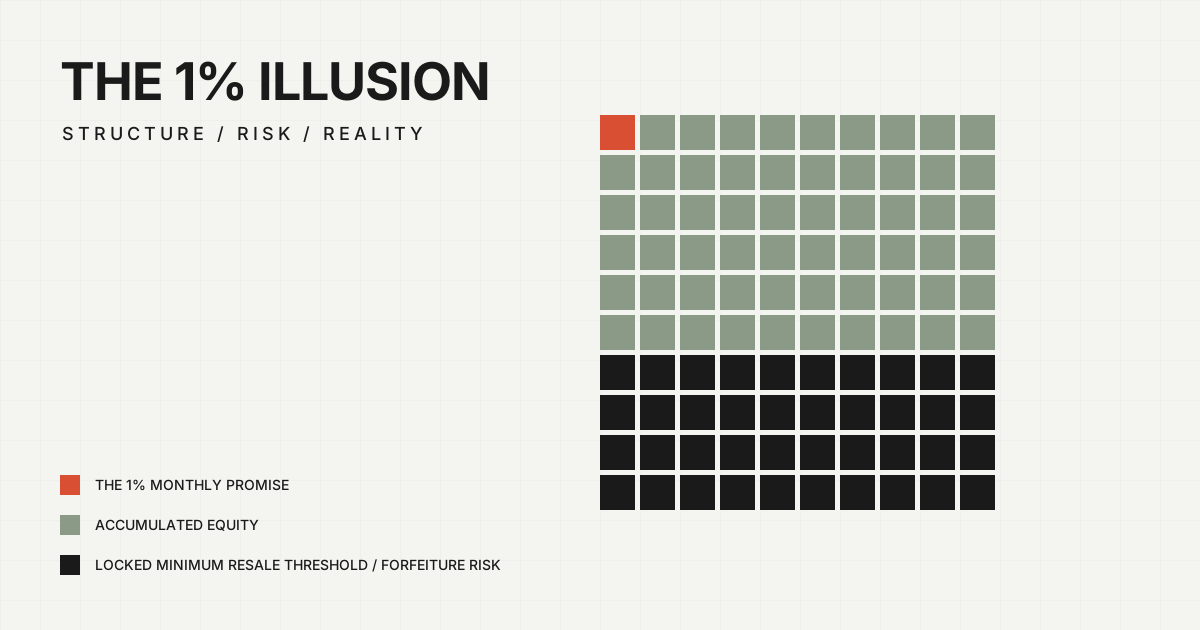
The 1% monthly payment plan has become Dubai's most effective sales instrument. On a property valued at ₹1 crore, the buyer pays 1% (₹1 lakh monthly) directly to the developer through construction and handover. There is typically no traditional bank financing or EMI interest.
However, there are three structural realities that this plan obscures:
- The Baseline Premium: Off-plan inventory offered on the 1% scheme is typically priced at a 15% to 20% premium to comparable ready inventory. That is ₹15-20 lakh of lost equity on day one, just for the convenience of installments.
- Forfeiture Risk: In a standard Dubai off-plan purchase contract governed by RERA Dubai, the developer is entitled to retain 30% to 40% of the paid amount if the buyer defaults or chooses to exit before handover.
- Minimum Resale Threshold: Most developers require a buyer to have paid a minimum of 30% to 40% before granting a No Objection Certificate (NOC) for resale. You are locked into the asset for approximately 30 to 40 months before you have a viable exit mechanism.
This is a specific product suited to an investor with stable income, a long time horizon, and no near-term liquidity needs. For a domestic equivalent, our mortgage calculator gives investors a clear picture of what comparable financing looks like.
THE GOLDEN VISA PROPOSITION: RESIDENCY IS NOT OWNERSHIP
An investment of one million dirham in qualifying freehold property grants the investor a long-term UAE residency visa (typically five to ten years).
But it is important to be precise: The Golden Visa does not confer citizenship.
After ten years of residence, the foreign investor does not become a citizen, does not gain voting rights, and does not gain the right to establish a majority-owned business in mainland sectors without a local Emirati partner. For anyone seeking to run a domestic, market-facing operation in Dubai, the structural constraints are real.
THE LIQUIDITY PROBLEM: WHAT DUBAI AGENTS DON'T PUT IN THE BROCHURE
Of all the variables, liquidity separates theory from reality with the greatest force. Liquidity is the variable that matters most when something goes wrong.
In Mohali, an investor with a problem has options. You can physically reach the asset, engage a trusted broker network, attend a negotiation, and close a transaction within weeks. You have proximity and jurisdiction on your side.
In Dubai, these advantages evaporate. You must rely entirely on an overseas brokerage network (typically the one that sold you the asset). You cannot enforce a sale through domestic legal channels.
The firms selling Indian investors Dubai property operate one-way pipelines. They come to Chandigarh to sell; they do not come to buy. When the time comes to exit, you are navigating a foreign market remotely with no local enforcement leverage. This is the single most consequential risk in the Dubai investment thesis.
CAPITAL REPATRIATION: THE FEMA REALITY OF BRINGING DUBAI RETURNS HOME
Under the Foreign Exchange Management Act (FEMA), Indian residents can invest overseas under the Liberalised Remittance Scheme (LRS) up to USD 250,000 per financial year.
The complication arises from tax residency. To legitimately claim UAE tax residency and extinguish Indian tax residency, an individual must:
- Spend fewer than 182 days in India in a financial year.
- Or meet the stricter conditions under the amended Finance Act 2020 for high-income individuals (120-day threshold).
For the vast majority of Indian investors who continue to live and work in India, the rental income repatriated becomes taxable in India, subject to the Double Taxation Avoidance Agreement (DTAA). The tax-free narrative, in their specific case, is not accurate. Read our property documents guide for compliance frameworks.
THE GEOPOLITICAL VARIABLE: ASSESSING RISK IN AN UNSTABLE REGION
Within India, an investor facing a developer dispute has access to RERA, consumer courts, and eventually the Supreme Court. The system is imperfect, but you are a citizen with full legal standing.
In Dubai, a foreign national investor facing a developer dispute has limited leverage. While UAE law provides protection (like escrow accounts for off-plan projects), the cost of cross-border litigation makes recovery materially harder. This is a tail risk, but for an investor putting their entire deployable capital into a single foreign unit, it must be priced.
WHY MOHALI REMAINS A FUNDAMENTALLY SOUND INVESTMENT MARKET IN 2026
The case for Mohali can be made on its own terms, without needing Dubai to fail. Mohali's investment thesis is driven by a durable regional identity aspiration with no viable substitute.
The Chandigarh Demand Corridor
Chandigarh is one of India's most aspirationally coveted addresses, but has no meaningful residential land left for new development. Mohali captures the spillover from this inelastic aspiration.
- Sector 82A & Airport Road: We have seen commercial units on Airport Road that were available at ₹3-4 crore jump to ₹12-16 crore simply because buyers moved with vision before the infrastructure arrived.
- IT City: The corporate rental market creates a yield case structurally different from speculative demand.
- Sector 88: Home to projects like Purab Premium Apartments, demonstrating state-supervised development credibility.
When Mohali becomes too expensive, buyers move to Zirakpur or Kharar. They do not move to Dubai. The demand cascade flows inward.
The Proximity and Liquidity Advantages
Proximity enables a site visit within two hours, a same-day meeting with a builder, and legal intervention through a local network. Real estate is a physical asset that benefits from an owner's active presence.
Furthermore, a well-priced residential asset in a prime Mohali sector (with clean title documentation and GMADA approvals) finds buyers. A seller with market knowledge can move an asset within a reasonable timeframe. Check our land listings to see assets that carry strong long-term appreciation logic where resale is operationally manageable.
The GMADA and RERA Structural Framework
Mohali's regulatory environment has matured significantly. GMADA provides a defined framework for plot development, and RERA Punjab provides a complaints mechanism. It represents a regulatory backstop that gives an Indian investor standing to fight with local courts and local advocates. See our flat buyer's guide.
A NOTE ON WHAT DUBAI DEVELOPERS ARE REALLY DOING IN INDIA
When a Dubai developer hosts a Chandigarh event at an ₹8 crore entry level, they are not selling a diversified investment strategy. They are moving inventory. Emaar's India expansion is not a vote of confidence in the Indian market over Dubai; it is a global developer taking its product to where the wealth is.
Projects like Affinity Belgravia and The Medallion exist within a domestic development landscape that is increasingly competing in build quality and design standards.
THE MARKET PROFILE SPLIT: WHO SHOULD ACTUALLY BE INVESTING WHERE

The Dubai versus Mohali question does not have a universal answer. It has a conditional answer.
The Dubai thesis is strong for investors who:
- Are genuinely relocating to the UAE (spending 6+ months annually) enabling authentic tax residency.
- Have substantial liquid capital already deployed in India, using Dubai for genuine diversification.
- Have minimal domestic operational obligations (no active legal disputes or businesses requiring physical management).
- Have a time horizon of 7 to 10 years minimum with no near-term liquidity requirements.
- Are buying completed, ready-to-rent inventory to avoid off-plan forfeiture risks.
The Mohali thesis remains the stronger choice for investors who:
- Are Punjab-based, Tricity-rooted, or have aspirational family ties to Chandigarh.
- Are managing active businesses or legal obligations that require their attention in northern India.
- Are deploying capital in the ₹50 lakh to ₹3 crore range (where Dubai's high transaction costs eat into yields).
- Prioritise asset proximity, immediate liquidity, and domestic legal recourse.
- Are investing for legacy and inheritance planning, where physical property within Indian jurisdiction carries title clarity.
REALTY HOLDING & MANAGEMENT CONSULTANTS: OUR POSITION
Realty Holding & Management Consultants does not take a commission on Dubai property sales. We have a track record of advising clients on Mohali, Aerocity, and GMADA-sector inventory, and a commitment to telling our clients what the numbers actually mean.
For the majority of Punjab-based investors deploying capital in the ₹50 lakh to ₹5 crore range, Mohali remains the more appropriate, more manageable, and more recoverable investment choice. The yield gap is real, but the liquidity gap is also real, and it cuts the other way.
If what you read describes your situation, let's talk. One 15-minute call. I will tell you directly what I would do. Book or WhatsApp.
RELATED READING
- Mohali Real Estate Investment Strategy 2026
- Property Rates in Mohali 2026: GMADA, Chandigarh, and Aerocity Guide
- Flat Buyer's Guide: Tricity Registry and Ownership
- Browse Flats in Aerocity Mohali
- Browse Flats in Sector 82A Mohali
- Browse Flats in IT City Mohali
- Browse Land Inventory in Mohali
- Mortgage Calculator
- Loan Eligibility Tool
- Price Trend Tool
Amritpal Singh is the founder of Realty Holding & Management Consultants, E328, Phase 8A, industrial area, mohali. With over 10 years across real estate development, government liaisoning, capital markets, and media, he has personally closed 180+ transactions across all property categories in Punjab. AMFI and NCFM certified.
Planning a property purchase in Mohali?
Use our free EMI Calculator for Mohali property to estimate your monthly payments before you visit the site →
Chat with an Advisor on WhatsApp →