The Mohali 2BHK Trap: What 'Super Area', Cooperative Societies, and Floor Ownership Actually Cost You

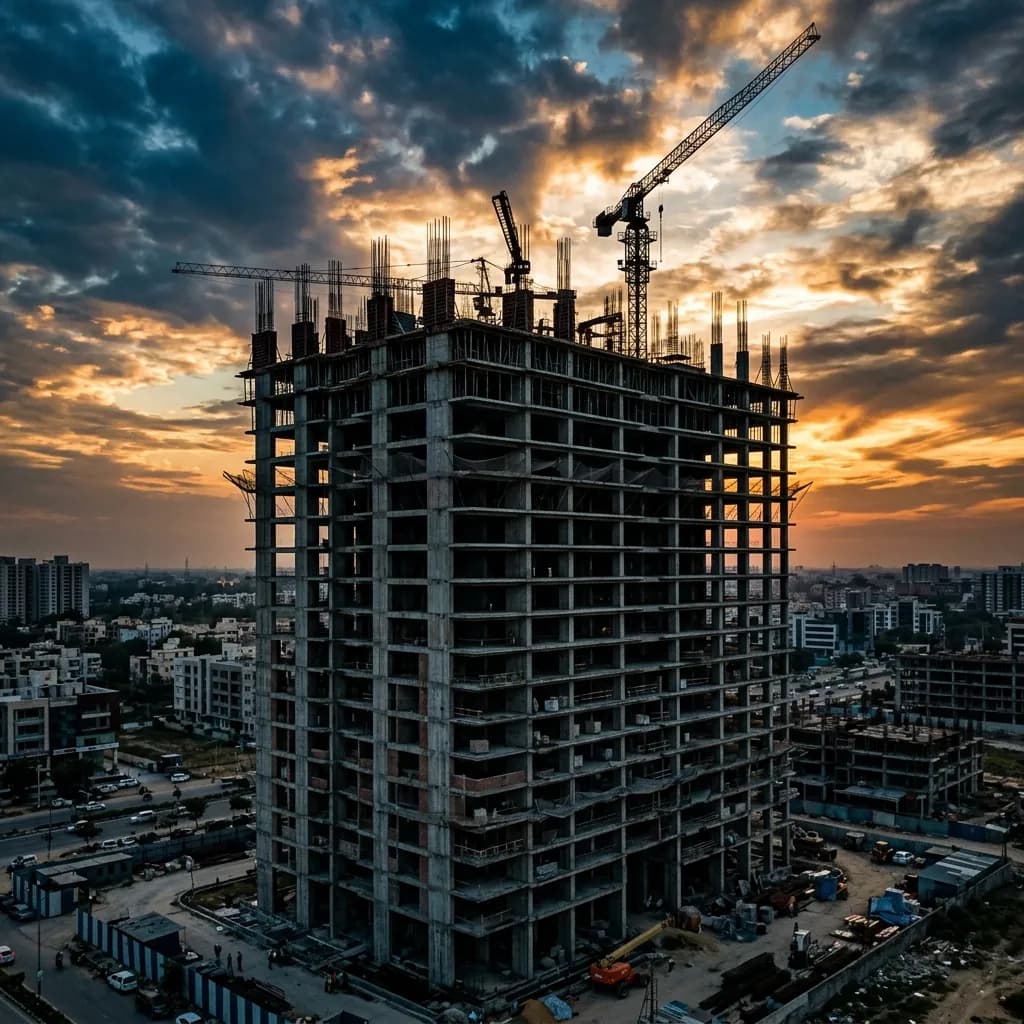
Executive Summary: In this buyer protection guide, Realty Holding & Management Consultants exposes the hidden legal and structural traps that catch flat buyers in Mohali. We analyze the exact math of builder loading factors, outline the ongoing litigation and transfer file risks in older cooperative societies, and explain the home loan constraints on independent kothi floors.
- Loading Factor: Builders routinely load 35% to 40% on super area, meaning an 1,100 sq.ft. flat offers only 650 sq.ft. of actual carpet area.
- Society Disputes: Multiple older cooperative societies over-allotted memberships (e.g., selling 400 shares for 300 physical flats), locking properties in GMADA litigation for a decade.
- Floor Mortgages: Independent kothi floors registered as undivided shares of a plot cannot secure bank financing without ground-floor owner signatures, which are rarely given. Before signing any booking form, verify the land-level registry and demand the carpet area in writing.
Navigating the Mohali flat buying traps requires vigilance; without checking three key legal and structural constraints first, families risk losing a decade of savings. Those three things are: what the carpet area actually is after the builder's loading factor is applied, whether the society you are buying into has a clean registry or is sitting on a litigation time bomb, and whether the floor you are purchasing can actually get you a home loan. Most buyers find out about all three after the money has moved. This piece covers each one directly so you do not have to learn them the hard way.
The ₹60 Lakh to ₹1.2 Crore Range: Why the Same Budget Tells Very Different Stories
Our team speaks to buyers every week searching across prominent Mohali zones, broadly the older cooperative belt around sectors 66 to 70, the newer private corridors running through sectors 78 to 91, and the Airport Road zone stretching toward sectors 115 to 117. All within a budget of ₹65 lakh to ₹1.2 crore. What surprises most of them is how dramatically the product changes depending on which zone they look in. For a detailed breakdown of current sector pricing, see our Mohali Property Rates Guide 2026.
In the sectors 78 to 91 corridor, a 2BHK in a newer private society comes in around ₹90 to ₹95 lakh. In the Aerocity-adjacent zone near sector 66A, the same budget of ₹1.05 to ₹1.10 crore gets you a newer construction with a rental of around ₹30,000 a month. In the older cooperative societies of the sectors 66 to 70 belt, that same ₹60 to ₹65 lakh can get you a spacious 3BHK, but with legal conditions attached that most buyers are not told about upfront. And on the Airport Road side toward sector 117, 2BHK options sit between ₹75 and ₹85 lakh, with 3BHKs ranging from ₹1 crore to ₹1.20 crore depending on the block and floor.
Each of these options is real. Each has a different risk profile.
A buyer who recently came to us put the yield question plainly. He was looking at units around the ₹1.10 to ₹1.20 crore mark. The rental on comparable units nearby was ₹30,000 a month. He said: "Rate ke hisab se to phir bhi kuch nahi banta hai."
He was right about the yield. At ₹30,000 a month, that is ₹3.6 lakh a year against a ₹1.2 crore investment. That is a 3% gross yield. After property tax, maintenance, and the odd vacancy, you are sitting at 2.5% or below.
If you are buying a Mohali flat to live off the rent immediately, the math does not work right now. You must adopt a long-term capital play—refer to our Mohali 5-Step Investment Framework for strategic guidelines.
But that is not the full picture.
The JLPL belt along Airport Road was trading commercial units at ₹3 to ₹4 crore a few years back. Those same units now trade at ₹12 to ₹16 crore. The buyers who acted when the infrastructure was still on paper, not yet on the ground, are the ones who made the real money. However, buying before construction begins comes with project delay hazards; check out our Mohali Prelaunch Property Guide to weigh the risks.
Residential property in high-growth Mohali corridors is a capital appreciation play. The rental income is a bonus, not the thesis. If your plan depends on the rent covering your EMI from day one, you are looking at the wrong product. Projects like Evoq Antalia or Marbella Grand on Airport Road represent luxury plays where appreciation outpaces yield by multiple factors.
With that framing set, here is what actually goes wrong when buyers start comparing options across this corridor.
Comparison of Mohali Property Types
| Property Type | Loading Factor | Registry Type | Loan Financeability | Typical Pricing |
|---|---|---|---|---|
| Private Developer Flat | High (25% - 40%) | Flat-Level Registry (GMADA) | High (All PSU/Private Banks) | ₹75L - ₹1.5Cr+ |
| Cooperative Society Flat | Moderate (15% - 25%) | Transfer File / Collective Land Registry | Distressed (Only selective cooperative banks) | ₹55L - ₹90L (Highly spacious) |
| Independent Kothi Floor | Low (5% - 15%) | Undivided Plot Share (50:30:20) | Challenging (Requires ground floor co-signature) | ₹65L - ₹1.2Cr |
The Super Area Lie Nobody in the Brochure Will Explain
From 1,100 Square Feet to 650: Where Did Your Flat Go?
Every flat in Mohali, across every zone and every price point, is sold on super area. That is a fact of the market. What buyers do not always understand before visiting the site is how far the gap between super area and carpet area can go.
A flat listed at 1,100 square feet super area will commonly deliver a carpet area of 650 to 700 square feet. The difference is absorbed by common areas: lobbies, stairwells, lift shafts, passages, external walls, and in some buildings, terrace or basement allocations. This is the loading factor.
An acceptable loading factor in the Mohali market is 25 to 30%. When a project loads 35% or above, the buyer is getting significantly less usable space than the listed number suggests.
Under RERA Punjab guidelines, advertising, selling, or booking apartments solely on a super area basis is illegal. Pricing and conveyance deeds must be based strictly on carpet area. However, in practice, many developers still present the super area in their marketing brochures to inflate the perceived space. It is a number that can completely change your experience of the flat once you are inside it.
At 1,100 square feet super area with a 40% loading factor, your actual usable space is around 660 square feet. That is a comfortable 1BHK by most standards. You paid for a 2BHK.
This gap shows up across every zone. It applies to resale units in the Aerocity belt just as much as it applies to newer inventory in the sectors 78 to 91 corridor or established societies toward the Airport Road side. The brochure will not mention it. The broker showing you the site will not bring it up unless you ask directly.
Before you visit any site, ask the seller or broker for the carpet area number in writing. If they can only give you super area, divide it by 1.35 as a conservative estimate. That is your real floor space.
The Single-Washroom Trap in Older Sector Configurations
There is a specific layout issue in older Chandigarh Housing Board configurations, particularly around the sectors 44 to 46 belt, that catches buyers who focus on price and overlook the floor plan.
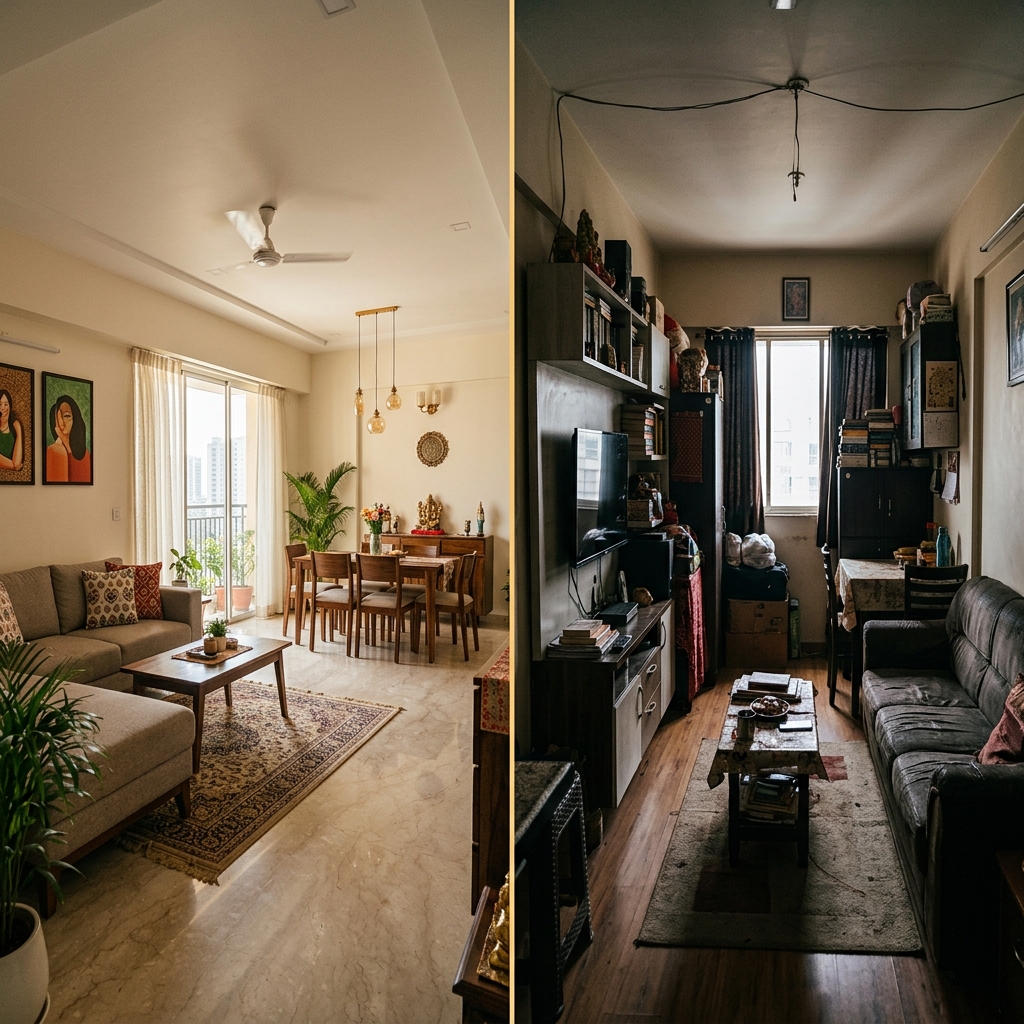
The 2BHK MIG units in these areas were built with a single washroom. In many cases, residents have since split the original bathroom into two using a partition, creating two smaller bathrooms from one original space.
The problem is twofold. First, the altered layout is technically a violation of the sanctioned map unless formally revised and approved. Second, when it comes time to resell, buyers with a 2BHK expectation will be put off by a cramped bathroom arrangement. It reduces your resale velocity.
These flats are not without merit. Registry happens, the societies are established, and prices are meaningfully lower than comparable private inventory in the newer zones. But factor in the cost of a proper bathroom renovation, and then factor in the resale discount that comes with it. That money needs to sit in your calculation before you pay the token.
Cooperative Society Flats: Risk Factors and Litigation History
When a Society Sells 400 Tokens for 300 Physical Flats
Some of the most attractive pricing in Mohali sits inside the older cooperative housing societies. In these pockets, a 1,400 to 1,500 square feet 3BHK can be found at a price that would only get you a 900 square foot 2BHK in a private developer project in the newer zones nearby.
That gap exists for a reason.
Some of these societies took membership fees and allotment deposits from more people than they had physical flats to deliver. A society that had 300 units to allot may have issued tokens to 400 families. The extra 100 families have been fighting that out in court for over a decade. Analyzing the cooperative society litigation history in Mohali reveals that Punjab property disputes under the Punjab Cooperative Societies Act, 1961 regularly run 12 to 15 years in civil courts.
In cases our firm has reviewed, families paid their full amounts, received their share certificates, and still could not get possession because someone else was already sitting in their allotted flat. Some of those occupants had paid far less, at a much earlier stage. Possession was the game from the beginning.
The person who moved in first and stayed is safer than the person who paid more and waited for the legal process to deliver their rightful allotment.
This pattern is not limited to one society or one zone. It runs across several of the older cooperative belts in Mohali. The entry price looks like value. The exit from a dispute, if you get caught in one, does not.
What a Transfer File Actually Means (And Who Inherits the Penalties)
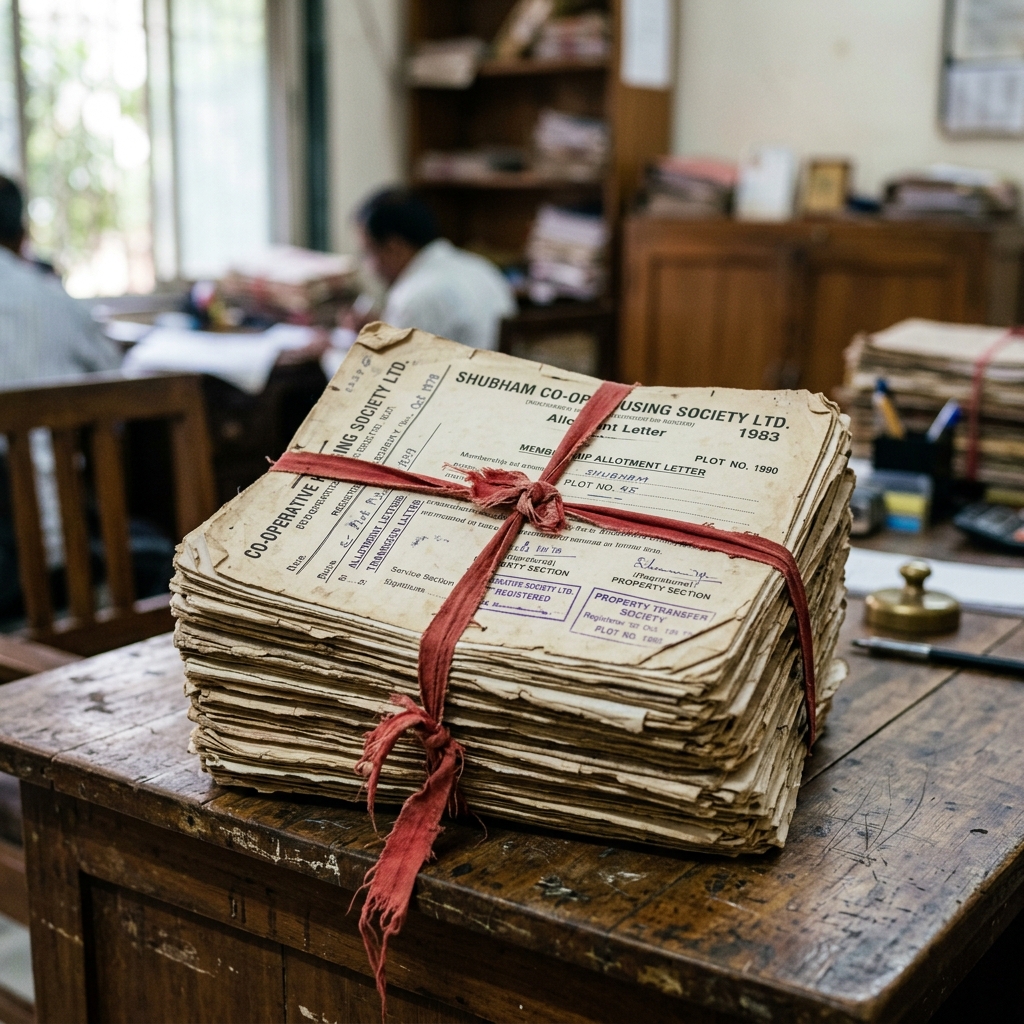
In societies where registry has not happened, flats are bought and sold through what the market calls a transfer file. The society's internal records are updated to show the new name. No government registry. No stamp duty transaction. No formal title. These transactions are governed internally by the cooperative under the Punjab Cooperative Societies Act, 1961, rather than standard property deeds registry.
When you buy on a transfer file, you are not just buying the flat. You are buying every liability attached to it from the day the original allotment was made.
If the original member owed penalties to the government body for delayed registry completion, that is your problem now. If the society owes GMADA penalties for construction violations or over-allotment, every member bears a portion. You will be told the amount is manageable and that others have already paid. Sometimes that is true. Often the final number, when it crystallises, is higher than the figure quoted at the time of purchase.
Some societies require members to collectively pool funds to complete the land registry process before individual flat registries can happen. In one such case in our experience, each member had to contribute ₹3 lakh or more to clear accumulated dues before their own flat could be registered. None of this was disclosed to buyers at the time of purchase.
The Registry Freeze, the GMADA Pressure, and the Cash-on-the-Side Transfer
Under government pressure to regularise cooperative societies, several of them have had their transfer processes officially frozen or capped. In one well-known case, a society can officially charge only ₹10,000 as a transfer fee. In practice, the amount being collected is significantly higher, with the excess adjusted against maintenance or other ledger entries.
This is the cash economy of distressed cooperative property. Everyone in the chain knows about it. Nobody talks about it formally. And when a dispute surfaces later, there is no paper trail to protect the buyer.
The question to ask before buying in any cooperative society is specific: has the land registry been completed? Not the flat registry. The land registry. If the society has not completed its land registry with GMADA or the relevant authority, flat-level registries are not possible regardless of what you are told. For sector-specific verification checklists, see our complete Tricity Flat Registry Guide. When evaluating a cooperative housing society's location, cross-reference its popular phase name with the planning grid using our Mohali Phases Map and Sector Guide.
Protect Your Capital: Somewhere right now, another buyer is being shown a "deal" in one of these societies. The gap between a safe purchase and a decade-long legal headache is one honest conversation before any money moves. If your situation looks anything like what you have read here, reach out to our team before you touch your cheque book. WhatsApp: 7814613916. No pitch. No pressure.
Independent Kothi Floors: Financing Limits and Roof Rights
The 50:30:20 Ownership Split That Catches Buyers Off Guard
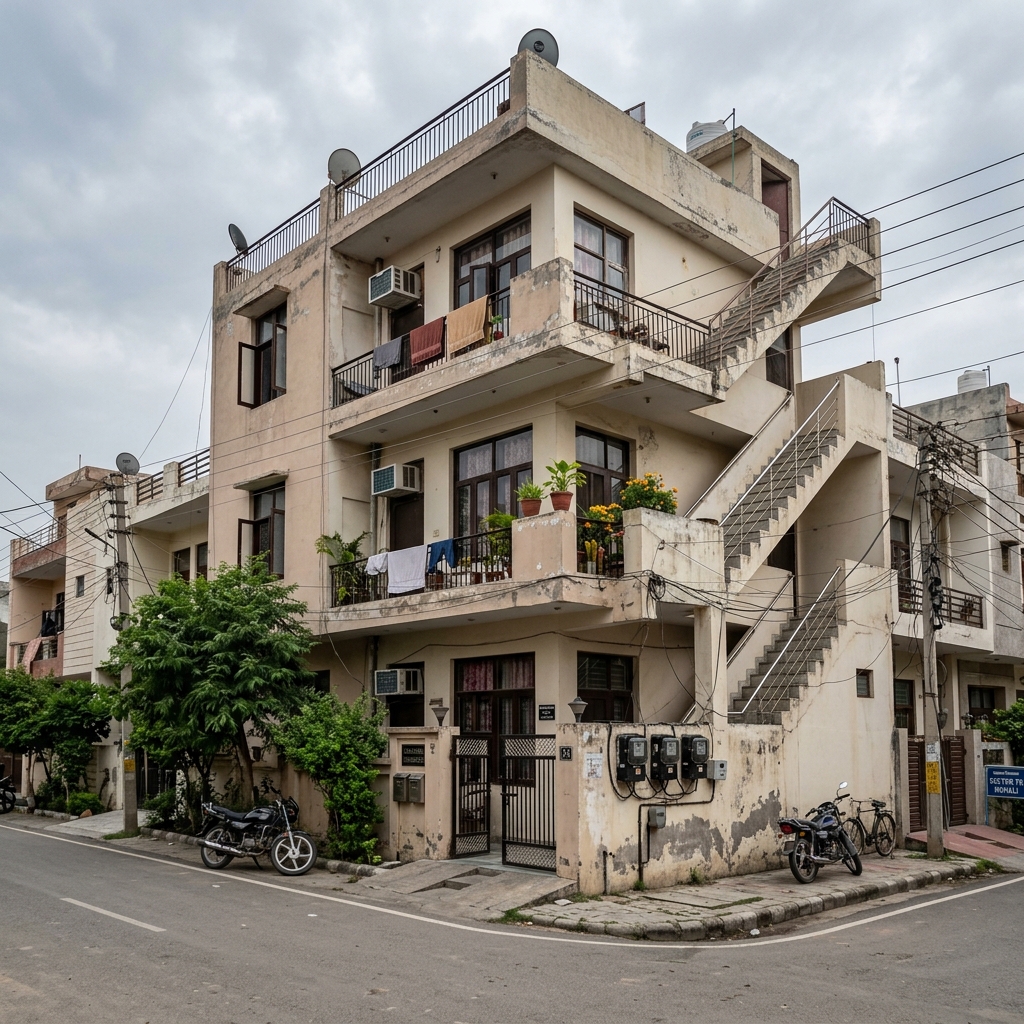
Independent kothi floors make up a significant part of the resale market across Mohali and Chandigarh, particularly in established residential zones where plot sizes run from 200 to 300 square yards. A plot is developed to three or four floors and each floor is sold separately. The prices are often lower than comparable flat options in the newer zones and the spaces are larger.
What buyers do not always understand before signing is how ownership actually works on a kothi floor.
The plot is not divided into separate titles floor by floor. All floor owners collectively hold an undivided share of the same plot. The standard distribution in this market is: ground floor holds 50% share, first floor holds 30%, and second floor holds 20%.
This matters at the time of resale, at the time of further construction, and most critically at the time of financing.
Understanding Independent Floor Financing Limits and Co-Owner Signatures
Home loans against independent floors are a consistent problem in this market, but only if they are structured as undivided shares. In Mohali, GMADA permits stilt+3 or stilt+4 configurations on residential plots. If the developer has registered a distinct floor-wise title with the Sub-Registrar (which includes a separate property ID and independent registry), public sector banks like SBI or private lenders like HDFC will finance them normally.
The mortgage trap occurs when the property is registered as an undivided share of the plot (such as the standard 50:30:20 partition file). In this setup, banks do not recognize the floor as a clean collateral title. To get a home loan, the bank typically needs all co-owners of the plot to sign as co-guarantors or co-mortgagors. That means the ground floor owner, and any other floor owners, must agree to be party to your loan documentation.
This does not happen in practice. The ground floor owner has no obligation to guarantee your borrowing. They have no benefit from doing so. Most will refuse.
The result is that kothi floor buyers often end up financing through personal loans, loans against existing property, or simply buying with available funds. These routes are more expensive or require pre-existing assets. If your purchase plan depends on a standard home loan, a kothi floor will not support it.
If a broker or seller tells you that bank loans are available on the floor you are considering, ask them to name the bank and the branch. Then call that branch directly. Do not take the broker's word on this.
Who Actually Owns the Terrace?
The top-floor owner's rights extend to the terrace in most cases. If you have purchased the second floor, the roof above you is your usable space.
What you can do with it is where buyers get confused.
Permanent construction, meaning additional rooms with a concrete slab and structural walls, requires a fresh building plan sanction. With the current FAR (Floor Area Ratio) increases across Mohali, an additional partial floor is technically possible on many plots. But that requires formal approval before any work begins.
Temporary enhancements such as a shed, artificial grass, a lightweight pergola, or a covered seating area without structural walls generally do not require a separate sanction and are widely done. These do not affect the rights of the floor owners below, and no other floor owner has any claim to the terrace unless it was specifically written into the original sale documentation.
The water tanks for all floors will typically sit on the terrace. All floor owners have access rights for maintenance purposes only. That access cannot be restricted. Everything else on the terrace belongs to the top floor owner.
What this means practically: if you are buying the top floor and want to eventually build an additional room or enclose the terrace, check the plot's current FAR status and get the building plan reviewed before you buy. The opportunity may well be there. Confirm it on paper, not in conversation.
Three Questions to Ask Before You Pay Anything
These are not theoretical questions. They came directly out of a real advisory conversation with a buyer searching across prominent Mohali zones, covering everything from cooperative society flats and CHB units to private developer inventory and independent floors. He was sharp, well-researched, and still almost walked into two of the traps described above. These questions are what changed the direction of that conversation.
Question 1: Has the registry happened, and at which level?
Registry at the individual flat level and registry at the land level are two different things. A cooperative society can have land registry completed without flat-level registries being done. It can also have partial land registry, covering one block but not another. Ask specifically: is the land registered? Is the flat registered? When was it done? Can you show the document?
Question 2: What is the carpet area, and what does the loading factor work out to?
Ask for the carpet area figure in writing. This applies whether you are looking at a private development in the newer zones or an older cooperative unit in the established belts. Calculate the loading factor yourself by dividing the difference between super area and carpet area by the super area. Anything above 35% deserves a hard question. Anything above 40% deserves a serious look at whether the asking price still makes sense.
Question 3: Is this purchase financeable, and by which bank?
If a home loan is needed, this question must be answered before the token is paid. Not after. Ask the seller which banks are currently providing loans against this specific property. Ask for a recent example. Then call that bank directly. In cooperative societies with pending registry, no loan is possible. On most independent floors, no loan is possible without co-guarantor consent.
To do this independently:
- Go to the official RERA Punjab Public Search Portal.
- Look up the project's registration number to verify both its sanctioned carpet area and its bank approval status.
- Compare the RERA registered carpet area numbers with the builder's brochure.
What the Market Will Not Tell You Directly
The Mohali property market between ₹60 lakh and ₹1.5 crore is full of genuine opportunity. Whether that is a well-priced resale unit in the Aerocity belt, a newer construction in the sectors 78 to 91 corridor, or a spacious cooperative flat in an older zone where the registry situation is clean, the options are real. The capital appreciation in well-chosen corridors has been significant. The rental yields, while modest now, rise as the area matures.
But the same market has cooperative societies that have been in litigation for 12 to 15 years with no resolution in sight. It has flats sold at 1,100 square feet where you will live in 650. It has floors that look like a bargain until you try to finance them or sell them. None of this is disclosed in a brochure. Most of it is not explained by the broker showing you the property, not because they are necessarily dishonest, but because it does not serve the transaction.
The buyers who come out well are not the ones who paid the least. They are the ones who asked the right questions before the money moved. Before calculating plot areas, plot dimensions, or registry charges, use our free Punjab Land Area Calculator to verify exact square footage and local revenue measurement units across Mohali and Rajpura.
Frequently Asked Questions (FAQ)
What is the loading factor trap in Mohali flats?
The loading factor in Mohali represents the common area added to your flat's actual usable space (carpet area). Builders routinely apply a 35% to 40% loading factor. This means a flat advertised as 1,100 sq.ft. "super area" will yield only about 650 to 700 sq.ft. of carpet area. Under RERA Punjab, it is illegal to charge a buyer solely on super area.
Why are home loans rejected for independent kothi floors in Mohali?
Home loans are frequently rejected because independent floors are registered as undivided shares of a plot rather than individual real estate units. Banks require all owners of the plot (including the ground floor owner) to sign as co-mortgagors, which co-owners rarely agree to do. However, stilt+3/4 floors with separate floor-wise titles registered with GMADA are fully financeable.
What is a transfer file in Mohali cooperative societies?
A transfer file is an internal society document used to hand over flat ownership when individual land registry is frozen by GMADA due to pending dues or litigation. Purchasing a transfer file under the Punjab Cooperative Societies Act, 1961 means you inherit all outstanding construction penalties and legal liabilities of the previous owner.
If you are evaluating a specific project in Mohali and want an independent read before you commit, book a 15-minute consultation. No pitch. No pressure. Just the answer.
Amritpal Singh is the MD of Realty Holding & Management Consultants, Sector 82A, Mohali. With over 10 years across real estate development, government liaisoning, capital markets, and media, he has personally closed 180+ transactions across all property categories in Punjab. AMFI and NCFM certified.
Editorial Disclaimer
Disclaimer: The information provided in this article is for educational and informational purposes only. Project records, litigation details, and regulatory compliance references are based on publicly documented RERA Punjab listings and news reports. Property buyers must perform independent due diligence and seek professional legal counsel before making financial commitments. The author and publisher are not liable for any investment decisions made based on this content.
Planning a property purchase in Mohali?
Use our free EMI Calculator for Mohali property to estimate your monthly payments before you visit the site →
Chat with an Advisor on WhatsApp →